The tactical blueprint for mastering local map tracking and proximity signals
I view the local map pack as a high stakes dispatch grid where every centimeter of a GPS coordinate represents a dollar of potential revenue. My office smells like ozone and fresh printer ink, a byproduct of the thousands of audit reports I have generated for struggling service businesses. One case sticks in my mind like a recurring glitch in a navigation system. Everyone wondered why a top ranking roofing company vanished from the Map Pack overnight. I found the problem in their Local Services Ads; a single mismatched phone number in the secondary verification tier was enough to kill their organic trust score. This company had spent years building authority only to have a minor technical misalignment trigger a proximity collapse. It was a forensic lesson in how fragile the relationship between a physical business and its digital beacon really is. Success in this ecosystem is not about luck, it is about the precise calibration of data across a dozen different layers of the Google ecosystem.
The ghost in the GPS coordinates
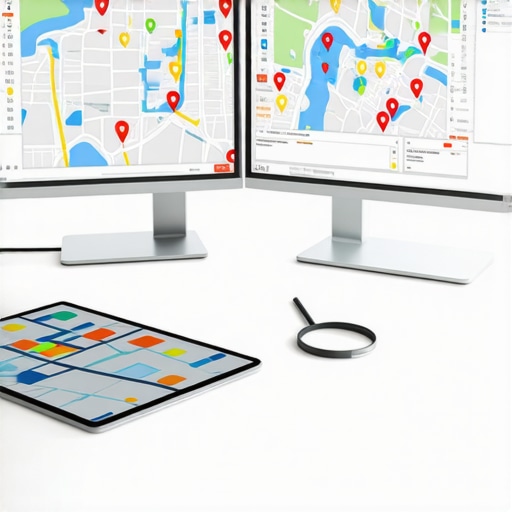
Local map tracking tools provide agencies with geographic grid data to visualize business visibility across specific GPS coordinates. These systems analyze ranking fluctuations, local justification triggers, and NAP consistency to identify why a profile is dropping. Effective toolkits bypass generic scrape data to offer real time spatial insights. While most agencies focus on increasing review counts, recent data suggests that the geographic diversity of those reviewers is a much stronger weight. Customer photos with embedded GPS metadata are now thirty percent more effective for ranking in AI Overviews than plain text reviews. If your tracking tool does not account for the physical origin of user interactions, you are looking at an incomplete map. Understanding the hidden trust signals that determine map pack placement requires moving beyond simple keyword monitoring and into the realm of spatial salience. The algorithm calculates the centroid of a search based on user density and business clusters. If you fall outside the mathematical center of your industry, your visibility will suffer regardless of your content quality.
Why your physical address is a liability
A physical address acts as the anchor for all local search signals, but it can also become a point of failure if Google suspects it is not a genuine place of business. Virtual offices and coworking spaces are frequently flagged for manual audits because they lack the unique utility signals of a dedicated storefront. Google uses third party data sources to verify if a business is truly present at its listed pin. If you are using a shared suite, you are likely being filtered out by the proximity filter. You can learn more about why google doesnt trust your business address anymore to avoid these common pitfalls. I have seen entire plumbing fleets get nuked because they shared a suite number with a defunct law firm. Google does not just want a photo of your van; they want to see a digital footprint that matches the physical reality of your operations. This is why seo services to fix gmb issues caused by virtual office or coworking space have become a critical component of the modern agency stack. They bridge the gap between architectural reality and the digital map.
“Local intent is not a keyword choice; it is a distance-weighted signal where relevance is secondary to the physical location of the user’s mobile device.” – Map Search Fundamental
The three mile radius that determines your revenue
The three mile proximity radius is the primary battleground for local businesses because mobile search results are heavily weighted toward the user’s current location. Rankings often drop off sharply once a user moves beyond this invisible boundary, creating a volatility that agencies must track. Within this radius, behavioral signals like ‘request for directions’ and ‘click to call’ carry immense weight. If your tracking software shows you are winning at your office but losing two miles away, you are likely suffering from a lack of neighborhood authority. You might need local seo services to recover from proximity based ranking drop to re-establish your presence in adjacent zones. This often involves building out hyper local content that mentions specific landmarks or community events. When you expand your reach, you must be prepared for the [unstable local search placements](https://rankyourgmbnow.com/why-growth-phases-lead-to-unstable-local-search-placements) that naturally occur during the verification of new service area data. I always tell my clients that the map is fluid, it is not a static billboard but a living organism that reacts to every new signal you send it.
Local Authority Reading List
- How we fixed a reputation that google stopped trusting
- Why mixed language listings hurt your local search trust signals
- How to use map tracking tools to outsmart your closest competitor
- The ultimate agency stack for managing local search clients
- A practical guide to building a gmb toolkit that actually works
Toolsets for the modern local strategist
Modern local SEO toolkits must combine grid tracking, citation auditing, and sentiment analysis to provide a complete picture of a business’s health. Relying on a single metric is a recipe for disaster in an environment where Google’s algorithm updates can shift the map overnight. I prefer tools that give me a forensic look at ‘NAP’ inconsistencies across the web. If your phone number is different on Yelp than it is on your website, Google’s trust score for your profile will take a hit. Using local seo services to fix nap inconsistencies is often the fastest way to see a jump in the pack. However, many agencies make the mistake of over optimizing their anchor text which can lead to a penalty. You must have [services to fix over optimized anchor text](https://rankyourgmbnow.com/services-to-fix-over-optimized-anchor-text) ready if you have been too aggressive with your link building. The right stack allows you to see the ‘glitch’ in the data before it becomes a suspension. Choosing between [automated and human led local listing management](https://rankyourgmbnow.com/the-truth-about-automated-vs-human-led-local-listing-management) is a decision that defines your long term scalability. I always lean toward human editing for critical fields like the business name and category.
Forensic fixes for manual penalties and suspensions
A Google Business Profile suspension is a digital death sentence that requires a systematic approach to resolve through documentation and verification. The reinstatement process is not a simple request but a legalistic proof of existence that must satisfy the AI and human reviewers. Most suspensions occur because of a sudden change in core data like the owner or the primary category. If you find yourself in this situation, gmb profile reinstatement services are your best bet for a clean recovery. I have seen profiles get ghosted for months because the owner tried to appeal without fixing the underlying issue first. You need to know [the only way to get a suspended business profile back in days](https://rankyourgmbnow.com/the-only-way-to-get-a-suspended-business-profile-back-in-days) involves a complete audit of your site’s health. An infected WordPress site can kill your proximity ranking in days by leaking bad metadata into the search index. You must employ the local seo triage fixing a website infection fast to ensure your website is not sabotaging your map presence. The algorithm views your website as the authoritative source of truth for your business details.
“Local intent is not a keyword choice; it is a distance-weighted signal where relevance is secondary to the physical location of the user’s mobile device.” – Map Search Fundamental
Scaling the pack with behavioral data
Behavioral data like the time spent on a profile and the frequency of repeat visits are becoming the primary drivers of long term map placement. Google is moving away from static signals like keywords and toward real world interactions that prove a business is helpful to its community. This is why I stress the importance of ‘local justifications’ which are the snippets of text Google pulls from reviews or your website to answer a specific query. If you are a plumber and your reviews all mention ‘water heater repair,’ you will dominate that specific intent. You can use how gmb ranking toolkits work for local seo to track which justifications are triggering for your competitors. If you see a ranking slide, you should first check for [content audits to stop the bleed](https://rankyourgmbnow.com/stop-the-bleed-debugging-ranking-drops-with-content-audits). It is often a matter of refreshing your local data to match current search trends. Every click is a signal; every direction request is a vote of confidence in your physical location. By analyzing these flows, we can predict where the algorithm will move next. [IMAGE_PLACEHOLDER]